Wähle Zeitzone
Die Zeitzone Ihres Profils:
Charged particles are ubiquitous in nature. In the form of atomic and molecular ions their interactions are crucial in many environments, from interstellar space to Earth’s atmosphere.
Since their advent in the early 90s, heavy ion storage rings have proven to be extremely versatile instruments for detailed studies of ionic systems in a variety of fields. Originally intended for experiments with nuclei and highly charged ions, heavy ion storage rings have also become invaluable tools in the fields of electron collisions and molecular physics. With the recent transition toward electrostatic devices, experiments with cluster ions and complex organic molecules become feasible.
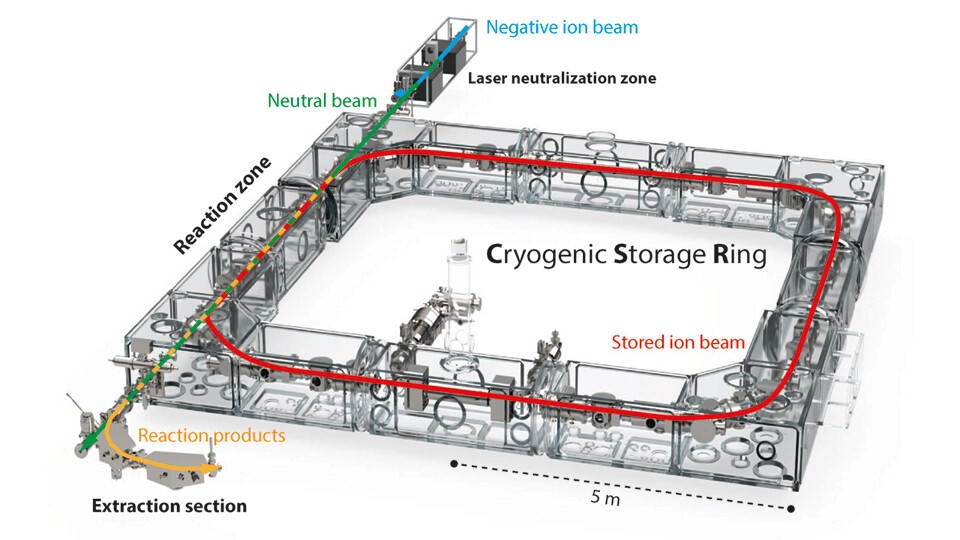
The Cryogenic Storage Ring (CSR) at the Max-Planck-Institut für Kernphysik in Heidelberg is currently the largest electrostatic storage ring project in the world. The CSR provides long storage times for atomic and molecular ions of almost arbitrary mass, at extremely high vacuum and low temperatures. I will give an overview of the recent developments in the field and the scientific program of the CSR, with special emphasis on experiments with relevance to astrophysics.
Alexandre Gumberidze - Department Atomic, Quantum & Fundamental Physics
