Wähle Zeitzone
Die Zeitzone Ihres Profils:
The interaction of highly charged ions with material surfaces leads to a plethora of phenomena ranging from the emission of more than 100 low-energy electrons per ion [1] to efficient surface nanostructure formation with unprecedented surface sensitivity [2] (see Fig. 1). For slow ions, i.e. ions with velocities well below the target’s Fermi velocity (about 1 a.u.), the processes are driven by the ion’s neutralization and correspondingly its potential energy transfer.
By using freestanding 2D materials such as graphene, MoS2, as well as heterostructures thereof and varying the ion’s kinetic energy, we gain control over the total interaction time of the ion and the target surface in the order of a few femtoseconds [3]. We find that charge exchange and potential energy deposition, i.e. ion de-excitation, display a characteristic timescale of 2-5 fs, which is much faster than expected. Only by taking multi-center inter-atomic de-excitation channels into account, the fast de-excitation can be explained [4]. The results show that ion charge exchange in solid surfaces is distinctly different from charge exchange with isolated atoms in the gas phase and that the potential energy deposition occurs predominantly in the first atomic layer of a solid.
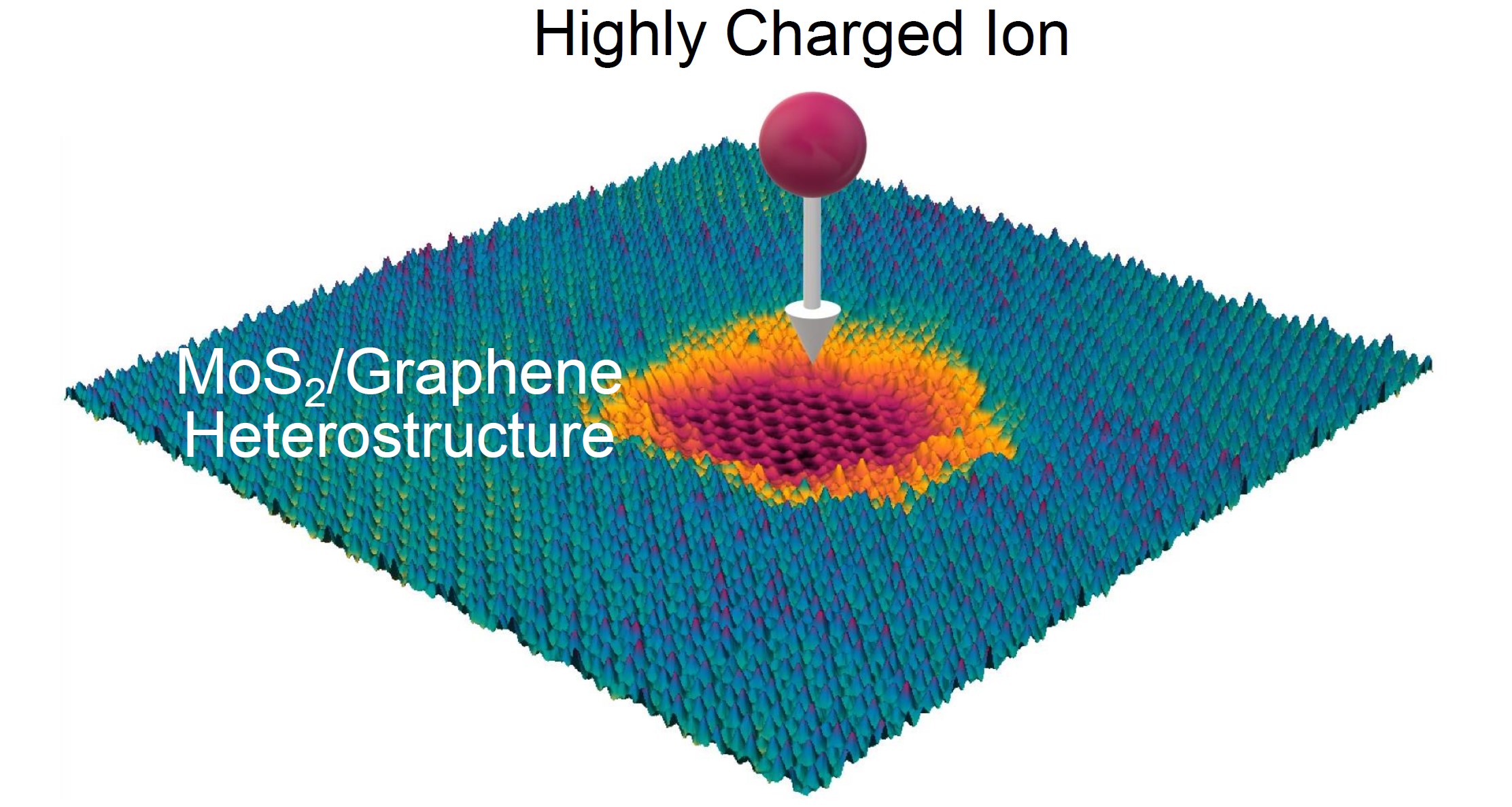
Figure 1: Scanning Transmission Electron Microscopy image of a freestanding MoS2/Graphene heterostructure after impact of a single 170keV (1.3keV/amu) Xe38+ ion. The topmost MoS2 layer is ruptured, the underlying graphene support stays intact.
[1] Schwestka, J. et al., Wilhelm, R.A. Charge-Exchange-Driven Low-Energy Electron Splash Induced by Heavy Ion Impact on Condensed Matter. J. Phys. Chem. Lett. 10, 4805–4811 (2019).
[2] Schwestka, J. et al., Wilhelm, R.A., Aumayr, F. Atomic-Scale Carving of Nanopores into a van der Waals Heterostructure with Slow Highly Charged Ions. ACS Nano 14, 10536–10543 (2020).
[3] Gruber, E., Wilhelm, R.A. et al. Ultrafast electronic response of graphene to a strong and localized electric field. Nat. Commun. 7, 13948 (2016).
[4] Wilhelm, R. A. et al. Interatomic Coulombic Decay: The Mechanism for Rapid Deexcitation of Hollow Atoms. Phys. Rev. Lett. 119, 103401 (2017).
Manuel Vogel - Atomic Physics Department