Wähle Zeitzone
Die Zeitzone Ihres Profils:
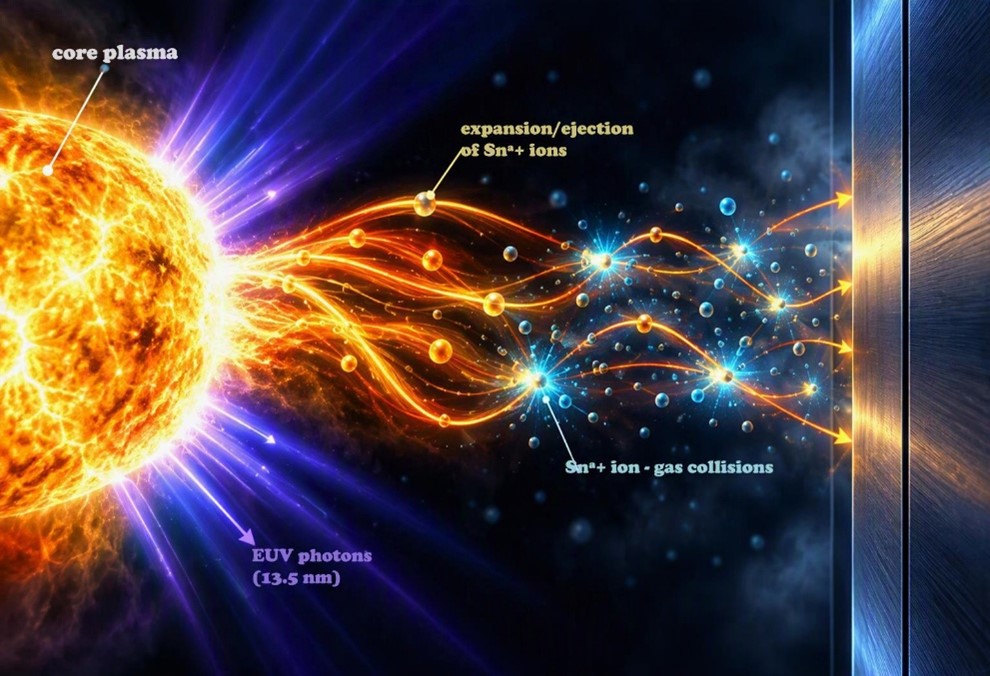
The forefront of modern photolithography is defined by extreme ultraviolet (EUV) lithography at 13.5 nm. Shorter wavelengths enable smaller feature sizes, and driving continued semiconductor miniaturization. EUV light is generated in laser-produced plasma (LPP) sources from tin ions. A 50 kHz stream of liquid tin droplets is first shaped by a low-energy laser pre-pulse and then ionized by a high-power main pulse, creating plasma at temperatures of ~500,000 K. The desired 13.5 nm radiation is emitted by highly charged tin ions within this plasma.
In this talk, we follow the fate of tin ions from their creation in the LPP source to their interactions with the surrounding H₂ buffer gas and plasma-facing materials. I will first discuss the “double magic” nature of Sn¹⁰⁺-Sn¹⁵⁺ ions, explaining why they emit so efficiently at 13.5 nm, and why ions escaping the plasma are rarely observed above charge state 8+. I will then focus on charge-changing collisions in the buffer gas used to mitigate tin debris.
Two questions arise. First, if charge transfer from Sn²⁺ to Sn⁺ is energetically forbidden, why is Sn⁺ the dominant final charge state in H₂? Second, why does highly endothermic two-electron capture by Sn³⁺ occur at low collision energies? Addressing the latter question led to the discovery of a new ion-molecule interaction mechanism: synchronous-sequential electron capture. Because this process requires transient expansion of the internuclear distance in the intermediate molecular ion, we termed it the Hop-Skip-Jump mechanism.
To proof the existence of the mechanism, we measured kinetic energy release (KER) spectra in Sn³⁺-H₂ collisions. The results provide strong evidence that Hop-Skip-Jump drives the unusually large two-electron capture cross sections. Extending these studies to other low-energy ion-molecule collision systems shows that Hop-Skip-Jump represents a universal pathway for two-electron capture in H₂.
[1] L. Oltra et al, Phys. Rev. Lett. (2025) 134, 093002
https://gsi-fair.zoom.us/j/63856816325
Meeting-ID: 638 5681 6325
Passcode: AP_Seminar
dial by phone
+496938079884,,63856816325#,,,,*8527227260# Deutschland
+496950500951,,63856816325#,,,,*8527227260# Deutschland
Alexandre Gumberidze - Department Atomic, Quantum & Fundamental Physics