Laser-Driven Particle Accelerators: From Laboratory Breakthroughs to Commercial Applications
durch
Lecture Hall
KBW
Laser-driven accelerators have advanced markedly in recent years, not only in bunch energy, charge and emittance but also in the reliability and reproducibility that practical deployment demands. At UT Austin we have developed the underlying science and are now working to carry it from the laboratory to the market.
I will present new results on laser-accelerated high-energy electron beams, specifically a new record of >20 GeV electrons, achieved in joined experiments at the ELI-NP 10 PW laser. LWFA electron beams now open applications in semiconductor R&D and metrology, medicine and materials science, and nuclear physics, chemistry, biology and pharmacology. Specific topics include advances in wakefield implementation, first results from a laser-driven FEL, progress toward high-repetition-rate systems, and the development of a laser-based light source service center.
A new project with our partner Tachyon Industrial extends this effort to ion accelerators, both conventional RF and laser-based, for radiation testing and antimatter research. As a first step we are recommissioning the Texas Petawatt Laser and designing a high-repetition-rate upgrade.
___________________________________________________________________________
Biosketch – Prof. B. M. Hegelich 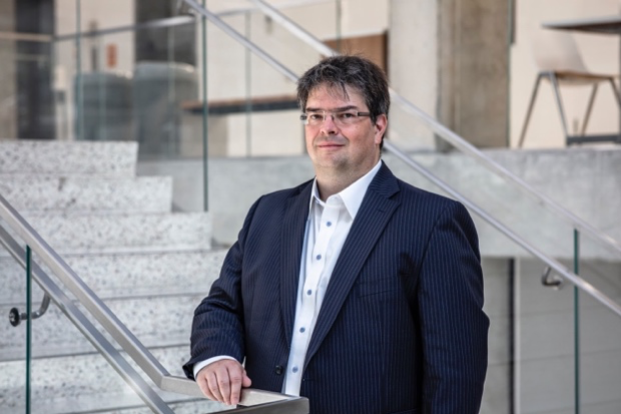
Prof. B. M. Hegelich a Professor at the University of Texas at Austin, leading the research group for Relativistic Quantum Photonics and. His research includes laser-driven particle and photon sources, and their applications, quantum effects in intense fields, relativistic laser-matter interaction, fusion research, high energy density physics, and ultrahigh intensity laser technology. He is the Co-founder and Chief Scientist of Tachyon Industrial, a deeptech company industrializing ion accelerators and antimatter. In 2021, he also founded TAU Systems Inc., the first company to industrialize laser-particle accelerators for radiation testing and lithography applications. From 2018-2019 Prof. Hegelich served as the Associate Director of the Center for Relativistic Laser Science, Institute of Basic Sciences, the world’s first multi-PW laser and Full Professor at the Gwangju Institute of Science and Technology. He was a scientist and Team Leader at Los Alamos National Laboratory, where he led the Trident Ultrahigh Intensity experiments. From 2008-2010 he was appointed Visiting Professor for ”Relativistic Laser Particle Acceleration for Nuclear Physics and Medicine” and Fellow at the Center for Advanced studies at the Ludwig-Maximilian-University München (LMU). Dr. Hegelich graduated from Napier University Edinburgh and Georg-August-University Göttingen. He obtained his doctorate at LMU München and the Max-Planck-Institute for Quantum Optics, pioneering ion acceleration with ultrahigh intensity lasers. His accomplishments include the current world record for laser-electron acceleration, demonstrating >20 GeV electrons over an acceleration distance of just 20cm, the first demonstration of of mono-energetic laser-ion acceleration, the first demonstration of ion acceleration in Transparent Overdense Plasmas and the development of the highest contrast laser. He co-authored over 150 peer reviewed publications with more than 11,000 citations.
Email: hegelich@physics.utexas.edu
LinkedIn profile: https://www.linkedin.com/in/bjorn-m-hegelich-b96a2954/
Google Scholar profile: https://scholar.google.com/citations?user=CydQVVgAAAAJ&hl=en
ORCID: https://orcid.org/my-orcid?orcid=0000-0003-4709-3112
Vincent Bagnoud